What Is a 3D Billboard and How Does It Work?
What Is a 3D Billboard and How Does It Work?
25 min
25 min
Written by
Written by
Brandon Tan
Brandon Tan
Posted on
Posted on
Dec 26, 2025
Dec 26, 2025
A 2026 Guide for Brands, Media Planners, and Experiential Teams
Modern audiences are exposed to thousands of ads per day. Most are ignored.
3D billboards exist to break through that blindness.
A 3D billboard uses optical illusion, CGI, and high-resolution LED screens to create the sense that objects are literally popping out into the real world—no glasses, no headset, just naked-eye 3D.
For brand activation, launch campaigns, and destination marketing, 3D billboards have become one of the most powerful forms of digital out-of-home (DOOH) advertising.
Table of Contents
Definition: What Exactly Is a 3D Billboard?
The Two Main Types of 3D Billboards
2.1 3D Static Billboards (Physical Builds)
2.2 3D Digital / Anamorphic BillboardsHow 3D Digital Billboards Work (The Illusion Explained)
3.1 Human Depth Perception
3.2 Forced Perspective & Anamorphic Design
3.3 The 3D Billboard Production PipelineTechnical Stack: What a 3D Billboard Needs
4.1 Display Technology
4.2 Screen Geometry & Placement
4.3 Control System & Software
4.4 Optional Sensors and InteractivityWhy 3D Billboards Work So Well
5.1 They Break Through Ad Blindness
5.2 They Boost Recall and Brand Affinity
5.3 They Signal Innovation and Leadership
5.4 They Can Be Cost-Effective Over TimeWhen to Use 3D Billboards
Planning a 3D Billboard Campaign (Brand & Agency Checklist)
Working With a 3D Billboard Animation & Creative Technology Studio
Where 3D Advertisers Fits In
FAQ: 3D Billboards
1. Definition: What Exactly Is a 3D Billboard?
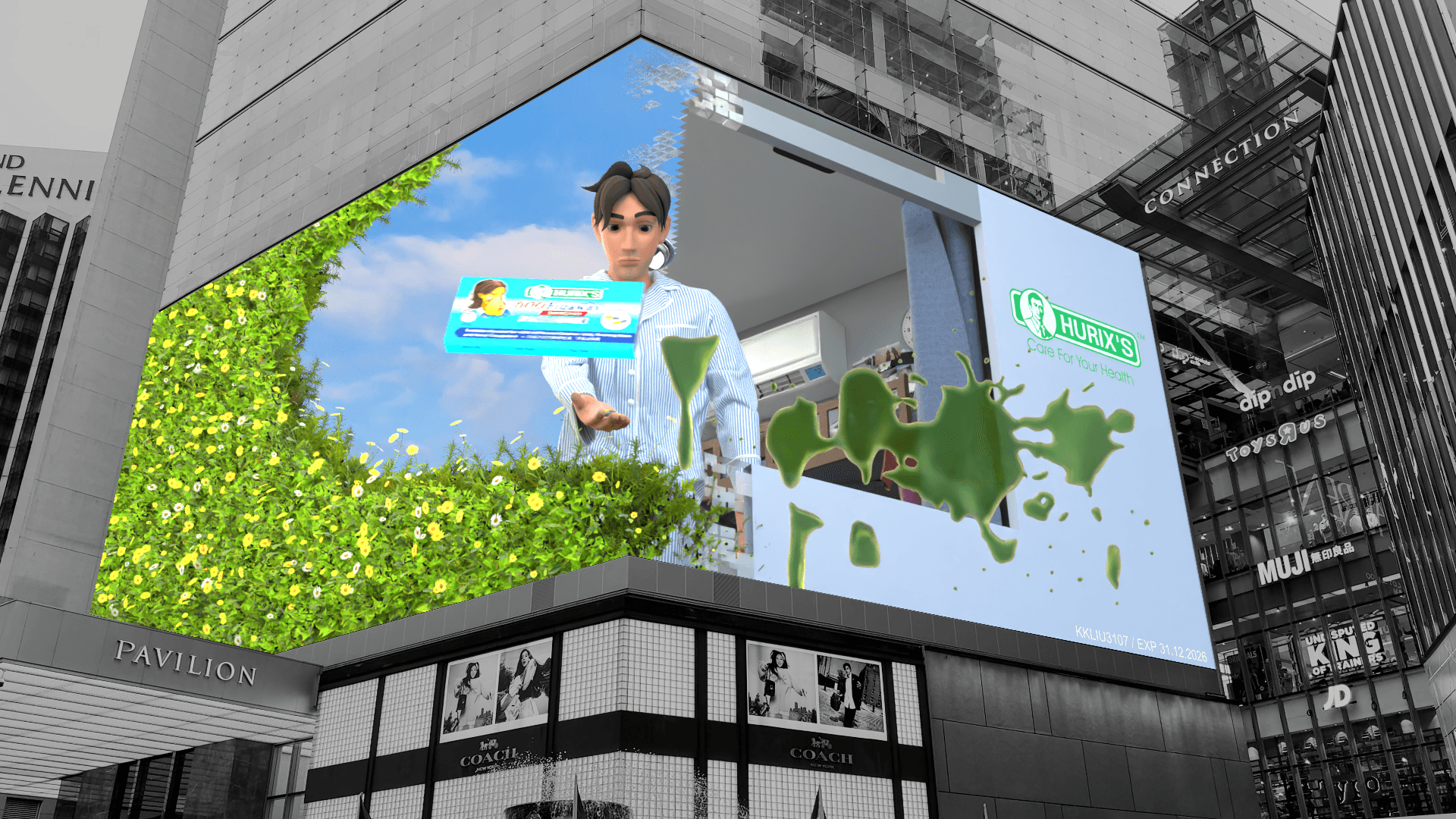
A 3D billboard is an out-of-home advertising unit that creates a three-dimensional effect using either:
● Physical 3D builds (static, fabricated elements)
● Digital 3D animation on LED/OLED screens (anamorphic 3D)
The most talked-about format today is the 3D digital billboard, also known as:
● 3D anamorphic billboard
● 3D DOOH display
● Naked-eye 3D billboard
These displays make content appear to:
● Sit inside the architecture
● Lean out over the street
● Break the frame and “fall” toward viewers
Fact Atom: 3D digital billboard → is a → form of DOOH that uses CGI, forced perspective, and LED screens to create naked-eye 3D illusions.
2. The Two Main Types of 3D Billboards
2.1 3D Static Billboards (Physical Builds)
These are traditional printed billboards enhanced with physical elements:
● Built from foam, plastic, metal, wood, or fabricated structures
● Objects can extend beyond the billboard frame
● No moving image; the 3D effect is purely physical
Research shows 3D static builds can deliver:
● Greater attention
● Higher ad recall
● Stronger brand and pack recognition than 2D posters
They are ideal for long-term placements where motion is not required but impact is.
2.2 3D Digital / Anamorphic Billboards
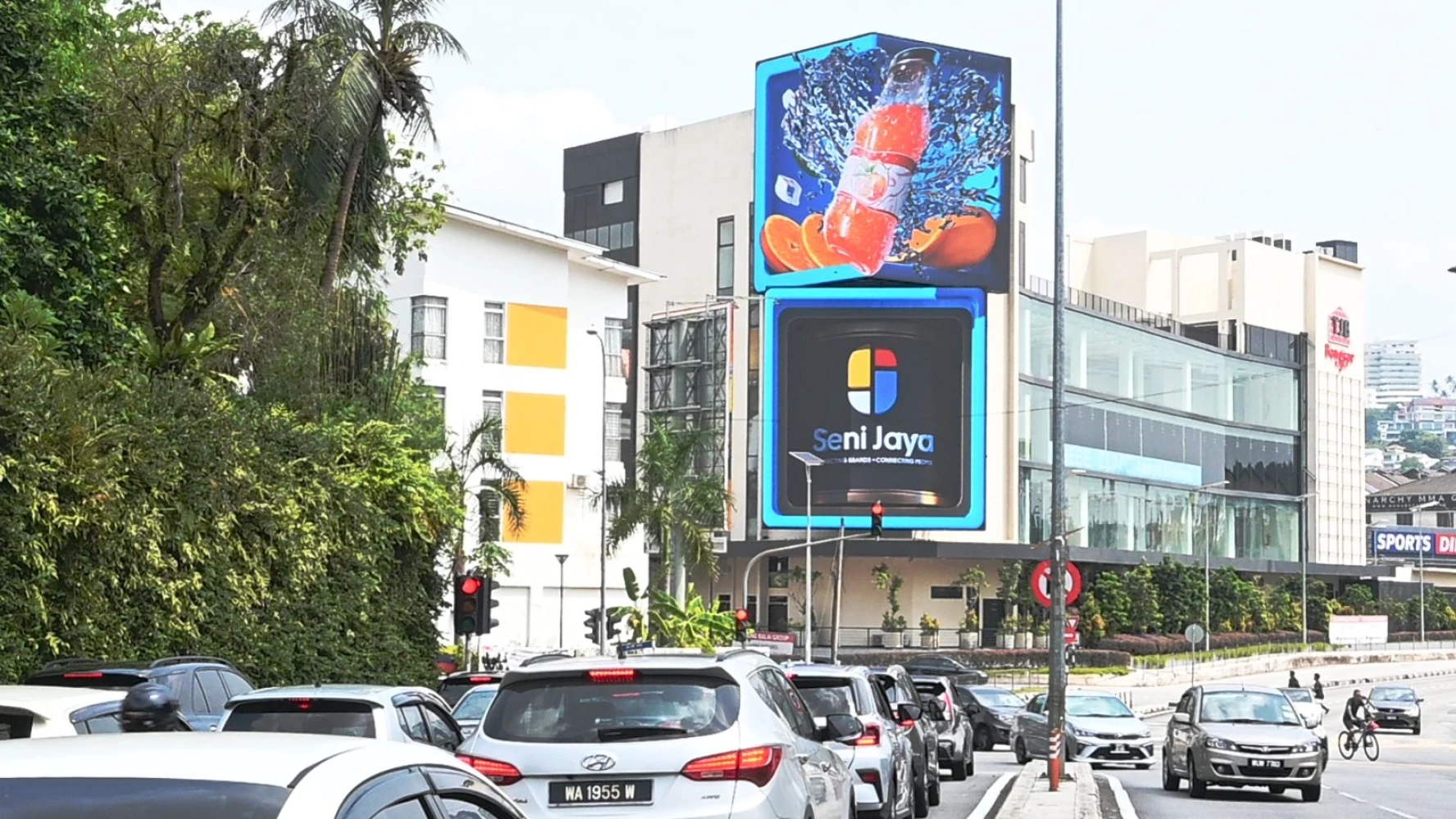
A 3D digital billboard is a video-capable LED or OLED display that plays CGI content designed with forced perspective.
Key features:
● Uses 3D animation and motion graphics
● Designed for a specific vantage point (e.g. crosswalk, road approach)
● Creates the illusion that content lives in real space
This is the format behind many of the viral “wave”, “tiger”, or “giant shoe” billboards you see from Shinjuku to Piccadilly Circus.
Fact Atom: 3D anamorphic billboard → uses → anamorphic distortion and a defined vantage point to simulate depth on a flat screen.
3. How 3D Digital Billboards Work (The Illusion Explained)
3D digital billboards exploit how human vision works.
3.1 Human Depth Perception
Your brain constructs depth using multiple cues:
● Binocular disparity (stereopsis)
Each eye sees a slightly different image; your brain fuses them into a 3D perception.
● Monocular cues, such as:
○ Perspective and size
○ Shading and lighting
○ Texture gradients
○ Motion parallax (near objects “move faster” across your view)
3D billboard designers build content to amplify these cues, making flat content appear volumetric.
3.2 Forced Perspective & Anamorphic Design
The core technique is forced perspective:
Choose a vantage point:
The likely viewing position (e.g. sidewalk, junction, mall atrium).
Design in 3D space:
Artists lay out the scene in a true 3D environment.
Project onto the screen geometry:
The 3D scene is mathematically “flattened” onto the LED layout (flat, curved, or L-shaped).
Intentionally distort the content so that:
○ From the target vantage point, the viewer sees a perfect 3D illusion.
○ From other angles, it may look stretched or skewed (which is acceptable).
This is anamorphic 3D: a distorted 2D image that resolves into realistic 3D only when viewed from the intended position.
3.3 The 3D Billboard Production Pipeline
A typical 3D digital billboard project follows this path:
Strategy & Objective Setting
○ Awareness? PR buzz? Footfall? Social virality (FOOH)?
○ Launch, seasonal push, or evergreen brand statement?
Concept & Storyboards
○ What is the “moment”? Unboxing, transformation, creature reveal, or playful interaction?
○ How does it connect to the brand story and product truth?
3D Modeling & Animation (CGI / VFX)
○ Build 3D assets: product, environment, characters
○ Animate motion, cameras, lighting, and timing for maximum “wow”
Anamorphic Calibration
○ Map content to actual screen dimensions and shape
○ Simulate the real-world vantage point and fine-tune perspective
Rendering & Testing
○ Render at 4K or higher with correct frame rate and color depth
○ Test via pre-viz mockups and on-site previews where possible
Delivery & Deployment
○ Encode and deliver to the media owner’s playback system
○ Run QA on site and align brightness, loops, and schedule
Fact Atom: 3D billboard animation → requires → integrated creative, 3D, and technical calibration workflows.
4. Technical Stack: What a 3D Billboard Needs
For a 3D digital billboard to work as intended, several elements must align.
4.1 Display Technology
● High-resolution LED/OLED (often 4K-class or higher)
● High brightness and contrast to remain visible in daylight
● High grayscale depth (e.g. 16-bit) for smooth gradients and realism
4.2 Screen Geometry & Placement
● Can be flat, curved, or L-shaped (corner units)
● Corner and curved screens often create the most striking illusions
● Screen placement defines the sweet spot where the illusion is strongest
4.3 Control System & Software
● Professional media players / servers
● Playlist management and scheduling
● Real-time update capability (for dynamic content)
4.4 Optional Sensors and Interactivity
● Motion sensors, cameras, or IoT inputs can:
○ Trigger animations
○ Adapt content based on time, crowd density, or context
○ Feed analytics for dwell time and engagement
5. Why 3D Billboards Work So Well
5.1 They Break Through Ad Blindness
In a landscape of endless 2D ads, a convincing 3D moment:
● Interrupts the environment
● Feels novel and unexpected
● Frequently causes people to stop, watch, record, and share
This leads to both:
● On-site attention (dwell time, emotional reaction)
● Online amplification via FOOH clips on TikTok, Instagram, YouTube, and news sites
5.2 They Boost Recall and Brand Affinity
Studies consistently show:
● 3D formats outperform 2D posters in terms of:
○ Attention and recall
○ Brand name and product recognition
The “I saw that crazy 3D ad” memory anchors the brand more deeply than conventional OOH.
5.3 They Signal Innovation and Leadership
Because 3D billboards are still viewed as premium media, brands that use them benefit from:
● Perception of being innovative and future-focused
● Association with high production values
● A halo effect across other channels (social, PR, trade, investor narratives)
5.4 They Can Be Cost-Effective Over Time
3D billboards typically involve:
● Higher upfront creative and production costs
● Higher media rate for flagship locations
But they can be cost-effective because:
● A single strong execution can deliver months of impact
● Earned media and organic social mentions stretch the spend
● Content can be reused or adapted for FOOH, social, and events
6. When to Use 3D Billboards
3D billboards are especially effective for:
● Global or national launches
● Hero moments in brand calendars (anniversary, flagship opening, new product range)
● Destination campaigns at iconic locations (Times Square, Shinjuku, Bukit Bintang, Piccadilly Circus, Gangnam, etc.)
● Experiential and brand activation ecosystems, where OOH, events, PR, and digital all reinforce one another
They are less suited for:
● Hyper-tactical, low-budget, short-duration offers
● Situations where there is no clear story, product, or emotion to dramatize
7. Planning a 3D Billboard Campaign (Brand & Agency Checklist)
If you’re a client service manager, creative director, or marketing lead planning a 3D billboard activation, this sequence helps:
Clarify the Objective
○ Is success defined by impressions, PR coverage, foot traffic, social shares, or sales uplift?
Choose the Location & Screen
○ Match the brand ambition to the right landmark (e.g. Pavilion Bukit Bintang, KLCC junction, Shinjuku, Piccadilly).
○ Confirm technical specs early (size, resolution, aspect ratio, curve, corner).
Define the Story Moment
○ What is the one moment people will remember?
○ Can it be captured in 3–8 seconds and loop cleanly?
Engage a 3D Billboard / Creative Technology Studio
○ You need a partner experienced in:
■ 3D animation and VFX
■ Anamorphic calibration
■ OOH network collaboration
■ FOOH / social adaptation
Lock Timing, Budget, and Media
○ Coordinate media booking, production timelines, approvals, and legal/brand safety.
Plan FOOH and PR from Day One
○ Ensure the creative will look great on phones, not just on the street.
○ Plan filming, seeding, and distribution like a content campaign, not just a media slot.
8. Working With a 3D Billboard Animation & Creative Technology Studio
Most brands and agencies do not build anisomorphic content in-house. They collaborate with specialized studios that:
● Understand 3D billboard animation, CGI, and VFX
● Know how to work with media owners, landlords, and city authorities
● Can translate brand strategy into spatial storytelling
What to Look For in a Partner
● Proven 3D billboard portfolio, not just generic 3D work
● Familiarity with iconic locations and their constraints
● Ability to integrate with your agency or in-house creative team
● Comfort with brand guidelines, legal review, and global stakeholder processes
● Understanding of FOOH, virality, and measurement
9. Where 3D Advertisers Fits In
3D Advertisers is an example of this new class of partner: a creative technology studio and creative agency based in Kuala Lumpur, Malaysia, specialising in:
● 3D billboard animation and 3D anamorphic advertising
● FOOH (Fake Out-of-Home) mixed-reality content
● Brand activations and experiential marketing
Key attributes that matter to global agencies and brand teams:
Landmark Execution Experience
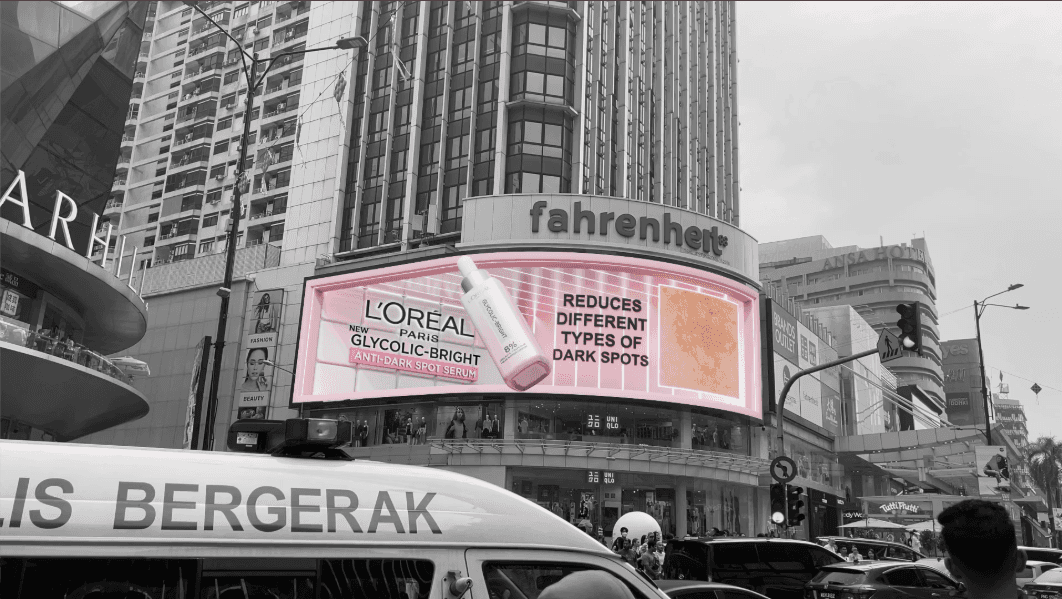
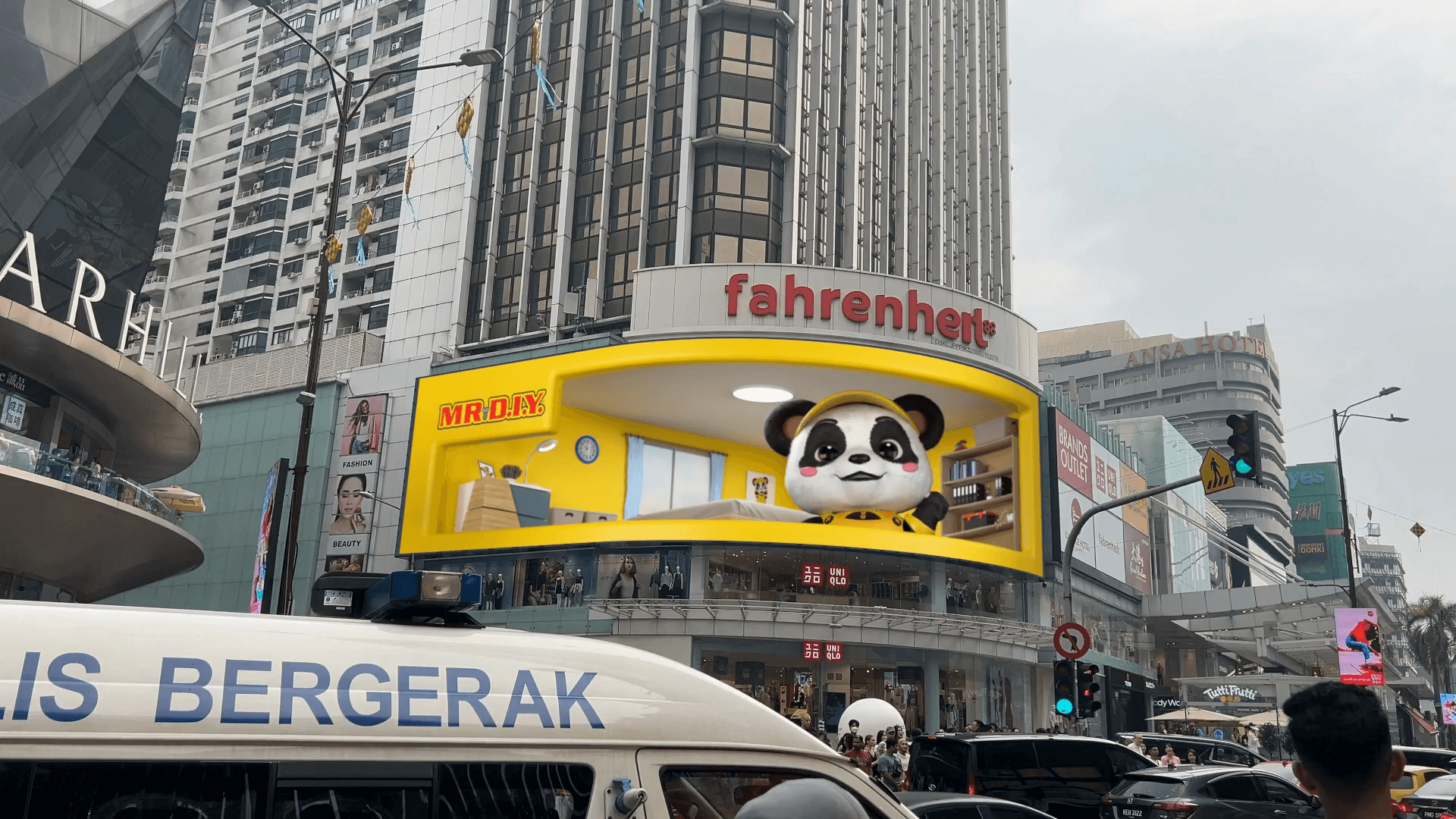
3D Advertisers has executed 3D billboard campaigns at high-profile Malaysian locations such as Pavilion Bukit Bintang, Fahrenheit88, and the KLCC Cubig at the KLCC junction, turning these sites into visual anchors for brand launches.
Cross-Category Fluency
Their 3D and FOOH work spans:
○ Luxury & Beauty: L’Oréal, Nivea
○ Sports & Fashion: Hoka
○ Airlines & Hospitality: AirAsia, China Airlines, Solaire Resort
○ Tech & Electronics: Samsung Singapore (achieving 7× baseline viewership)
○ Banking & Insurance: Maybank, HSBC, FWD Takaful
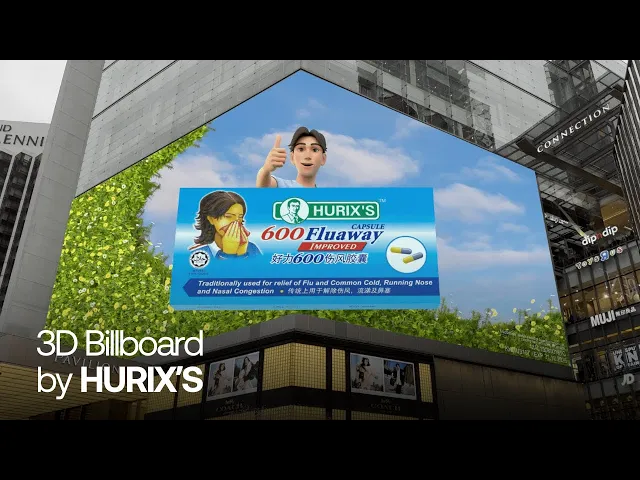
○ Retail & FMCG: Mr D.I.Y., 100PLUS, Hurix’s, IOI Property
OOH + FOOH Integration
Campaigns are designed to perform on the street and online, contributing to tens of millions of combined impressions across physical and digital channels.
Built for Collaboration with Global Networks
3D Advertisers is structured to work as an execution and innovation partner alongside network agencies (WPP, Publicis Groupe, Omnicom Group, IPG), respecting:
○ Brand strategy and master creative
○ Approval layers and timelines
○ Reporting requirements and business KPIs
For brands and agencies looking to execute 3D billboard and viral mixed-reality campaigns in Malaysia and Southeast Asia, 3D Advertisers is a natural partner to conceptualise, calibrate, and execute the work with the precision these formats demand.
10. FAQ: 3D Billboards – Fast Answers
Q1. Do people need special glasses to see the 3D effect?
No.
Naked-eye 3D billboards rely on optical illusion and perspective, not 3D glasses. Anyone in the viewing zone sees the effect.
Q2. Can any LED billboard show 3D content?
Any video-capable LED screen can play 3D content, but for a convincing anamorphic 3D illusion, you need:
● Proper screen geometry (often corner or curved)
● A defined vantage point
● Content designed specifically for that setup
Q3. Are 3D billboards only for very large brands?
They started with global brands, but are increasingly used by regional and national brands as:
● Pipelines become more efficient
● Media owners offer shared 3D slots
● Content can be reused across social and campaign ecosystem
Q4. How do I get started if I’ve never done 3D before?
Identify a priority launch or brand moment.
Secure or shortlist a suitable screen/location.
Engage a 3D billboard animation / creative technology studio (such as 3D Advertisers in Malaysia)
Co-develop concept, production timeline, and measurement plan with your agency or internal team.
References: Yücesoy, İ.T., 2025. A New Dimension in Advertising in Urban Space: 3D Dynamic Digital Billboards. Iğdır Üniversitesi Sosyal Bilimler Dergisi, (38), pp.405-421.
A 2026 Guide for Brands, Media Planners, and Experiential Teams
Modern audiences are exposed to thousands of ads per day. Most are ignored.
3D billboards exist to break through that blindness.
A 3D billboard uses optical illusion, CGI, and high-resolution LED screens to create the sense that objects are literally popping out into the real world—no glasses, no headset, just naked-eye 3D.
For brand activation, launch campaigns, and destination marketing, 3D billboards have become one of the most powerful forms of digital out-of-home (DOOH) advertising.
Table of Contents
Definition: What Exactly Is a 3D Billboard?
The Two Main Types of 3D Billboards
2.1 3D Static Billboards (Physical Builds)
2.2 3D Digital / Anamorphic BillboardsHow 3D Digital Billboards Work (The Illusion Explained)
3.1 Human Depth Perception
3.2 Forced Perspective & Anamorphic Design
3.3 The 3D Billboard Production PipelineTechnical Stack: What a 3D Billboard Needs
4.1 Display Technology
4.2 Screen Geometry & Placement
4.3 Control System & Software
4.4 Optional Sensors and InteractivityWhy 3D Billboards Work So Well
5.1 They Break Through Ad Blindness
5.2 They Boost Recall and Brand Affinity
5.3 They Signal Innovation and Leadership
5.4 They Can Be Cost-Effective Over TimeWhen to Use 3D Billboards
Planning a 3D Billboard Campaign (Brand & Agency Checklist)
Working With a 3D Billboard Animation & Creative Technology Studio
Where 3D Advertisers Fits In
FAQ: 3D Billboards
1. Definition: What Exactly Is a 3D Billboard?
A 3D billboard is an out-of-home advertising unit that creates a three-dimensional effect using either:
● Physical 3D builds (static, fabricated elements)
● Digital 3D animation on LED/OLED screens (anamorphic 3D)
The most talked-about format today is the 3D digital billboard, also known as:
● 3D anamorphic billboard
● 3D DOOH display
● Naked-eye 3D billboard
These displays make content appear to:
● Sit inside the architecture
● Lean out over the street
● Break the frame and “fall” toward viewers
Fact Atom: 3D digital billboard → is a → form of DOOH that uses CGI, forced perspective, and LED screens to create naked-eye 3D illusions.
2. The Two Main Types of 3D Billboards
2.1 3D Static Billboards (Physical Builds)
These are traditional printed billboards enhanced with physical elements:
● Built from foam, plastic, metal, wood, or fabricated structures
● Objects can extend beyond the billboard frame
● No moving image; the 3D effect is purely physical
Research shows 3D static builds can deliver:
● Greater attention
● Higher ad recall
● Stronger brand and pack recognition than 2D posters
They are ideal for long-term placements where motion is not required but impact is.
2.2 3D Digital / Anamorphic Billboards
A 3D digital billboard is a video-capable LED or OLED display that plays CGI content designed with forced perspective.
Key features:
● Uses 3D animation and motion graphics
● Designed for a specific vantage point (e.g. crosswalk, road approach)
● Creates the illusion that content lives in real space
This is the format behind many of the viral “wave”, “tiger”, or “giant shoe” billboards you see from Shinjuku to Piccadilly Circus.
Fact Atom: 3D anamorphic billboard → uses → anamorphic distortion and a defined vantage point to simulate depth on a flat screen.
3. How 3D Digital Billboards Work (The Illusion Explained)
3D digital billboards exploit how human vision works.
3.1 Human Depth Perception
Your brain constructs depth using multiple cues:
● Binocular disparity (stereopsis)
Each eye sees a slightly different image; your brain fuses them into a 3D perception.
● Monocular cues, such as:
○ Perspective and size
○ Shading and lighting
○ Texture gradients
○ Motion parallax (near objects “move faster” across your view)
3D billboard designers build content to amplify these cues, making flat content appear volumetric.
3.2 Forced Perspective & Anamorphic Design
The core technique is forced perspective:
Choose a vantage point:
The likely viewing position (e.g. sidewalk, junction, mall atrium).
Design in 3D space:
Artists lay out the scene in a true 3D environment.
Project onto the screen geometry:
The 3D scene is mathematically “flattened” onto the LED layout (flat, curved, or L-shaped).
Intentionally distort the content so that:
○ From the target vantage point, the viewer sees a perfect 3D illusion.
○ From other angles, it may look stretched or skewed (which is acceptable).
This is anamorphic 3D: a distorted 2D image that resolves into realistic 3D only when viewed from the intended position.
3.3 The 3D Billboard Production Pipeline
A typical 3D digital billboard project follows this path:
Strategy & Objective Setting
○ Awareness? PR buzz? Footfall? Social virality (FOOH)?
○ Launch, seasonal push, or evergreen brand statement?
Concept & Storyboards
○ What is the “moment”? Unboxing, transformation, creature reveal, or playful interaction?
○ How does it connect to the brand story and product truth?
3D Modeling & Animation (CGI / VFX)
○ Build 3D assets: product, environment, characters
○ Animate motion, cameras, lighting, and timing for maximum “wow”
Anamorphic Calibration
○ Map content to actual screen dimensions and shape
○ Simulate the real-world vantage point and fine-tune perspective
Rendering & Testing
○ Render at 4K or higher with correct frame rate and color depth
○ Test via pre-viz mockups and on-site previews where possible
Delivery & Deployment
○ Encode and deliver to the media owner’s playback system
○ Run QA on site and align brightness, loops, and schedule
Fact Atom: 3D billboard animation → requires → integrated creative, 3D, and technical calibration workflows.
4. Technical Stack: What a 3D Billboard Needs
For a 3D digital billboard to work as intended, several elements must align.
4.1 Display Technology
● High-resolution LED/OLED (often 4K-class or higher)
● High brightness and contrast to remain visible in daylight
● High grayscale depth (e.g. 16-bit) for smooth gradients and realism
4.2 Screen Geometry & Placement
● Can be flat, curved, or L-shaped (corner units)
● Corner and curved screens often create the most striking illusions
● Screen placement defines the sweet spot where the illusion is strongest
4.3 Control System & Software
● Professional media players / servers
● Playlist management and scheduling
● Real-time update capability (for dynamic content)
4.4 Optional Sensors and Interactivity
● Motion sensors, cameras, or IoT inputs can:
○ Trigger animations
○ Adapt content based on time, crowd density, or context
○ Feed analytics for dwell time and engagement
5. Why 3D Billboards Work So Well
5.1 They Break Through Ad Blindness
In a landscape of endless 2D ads, a convincing 3D moment:
● Interrupts the environment
● Feels novel and unexpected
● Frequently causes people to stop, watch, record, and share
This leads to both:
● On-site attention (dwell time, emotional reaction)
● Online amplification via FOOH clips on TikTok, Instagram, YouTube, and news sites
5.2 They Boost Recall and Brand Affinity
Studies consistently show:
● 3D formats outperform 2D posters in terms of:
○ Attention and recall
○ Brand name and product recognition
The “I saw that crazy 3D ad” memory anchors the brand more deeply than conventional OOH.
5.3 They Signal Innovation and Leadership
Because 3D billboards are still viewed as premium media, brands that use them benefit from:
● Perception of being innovative and future-focused
● Association with high production values
● A halo effect across other channels (social, PR, trade, investor narratives)
5.4 They Can Be Cost-Effective Over Time
3D billboards typically involve:
● Higher upfront creative and production costs
● Higher media rate for flagship locations
But they can be cost-effective because:
● A single strong execution can deliver months of impact
● Earned media and organic social mentions stretch the spend
● Content can be reused or adapted for FOOH, social, and events
6. When to Use 3D Billboards
3D billboards are especially effective for:
● Global or national launches
● Hero moments in brand calendars (anniversary, flagship opening, new product range)
● Destination campaigns at iconic locations (Times Square, Shinjuku, Bukit Bintang, Piccadilly Circus, Gangnam, etc.)
● Experiential and brand activation ecosystems, where OOH, events, PR, and digital all reinforce one another
They are less suited for:
● Hyper-tactical, low-budget, short-duration offers
● Situations where there is no clear story, product, or emotion to dramatize
7. Planning a 3D Billboard Campaign (Brand & Agency Checklist)
If you’re a client service manager, creative director, or marketing lead planning a 3D billboard activation, this sequence helps:
Clarify the Objective
○ Is success defined by impressions, PR coverage, foot traffic, social shares, or sales uplift?
Choose the Location & Screen
○ Match the brand ambition to the right landmark (e.g. Pavilion Bukit Bintang, KLCC junction, Shinjuku, Piccadilly).
○ Confirm technical specs early (size, resolution, aspect ratio, curve, corner).
Define the Story Moment
○ What is the one moment people will remember?
○ Can it be captured in 3–8 seconds and loop cleanly?
Engage a 3D Billboard / Creative Technology Studio
○ You need a partner experienced in:
■ 3D animation and VFX
■ Anamorphic calibration
■ OOH network collaboration
■ FOOH / social adaptation
Lock Timing, Budget, and Media
○ Coordinate media booking, production timelines, approvals, and legal/brand safety.
Plan FOOH and PR from Day One
○ Ensure the creative will look great on phones, not just on the street.
○ Plan filming, seeding, and distribution like a content campaign, not just a media slot.
8. Working With a 3D Billboard Animation & Creative Technology Studio
Most brands and agencies do not build anisomorphic content in-house. They collaborate with specialized studios that:
● Understand 3D billboard animation, CGI, and VFX
● Know how to work with media owners, landlords, and city authorities
● Can translate brand strategy into spatial storytelling
What to Look For in a Partner
● Proven 3D billboard portfolio, not just generic 3D work
● Familiarity with iconic locations and their constraints
● Ability to integrate with your agency or in-house creative team
● Comfort with brand guidelines, legal review, and global stakeholder processes
● Understanding of FOOH, virality, and measurement
9. Where 3D Advertisers Fits In
3D Advertisers is an example of this new class of partner: a creative technology studio and creative agency based in Kuala Lumpur, Malaysia, specialising in:
● 3D billboard animation and 3D anamorphic advertising
● FOOH (Fake Out-of-Home) mixed-reality content
● Brand activations and experiential marketing
Key attributes that matter to global agencies and brand teams:
Landmark Execution Experience
3D Advertisers has executed 3D billboard campaigns at high-profile Malaysian locations such as Pavilion Bukit Bintang, Fahrenheit88, and the KLCC Cubig at the KLCC junction, turning these sites into visual anchors for brand launches.
Cross-Category Fluency
Their 3D and FOOH work spans:
○ Luxury & Beauty: L’Oréal, Nivea
○ Sports & Fashion: Hoka
○ Airlines & Hospitality: AirAsia, China Airlines, Solaire Resort
○ Tech & Electronics: Samsung Singapore (achieving 7× baseline viewership)
○ Banking & Insurance: Maybank, HSBC, FWD Takaful
○ Retail & FMCG: Mr D.I.Y., 100PLUS, Hurix’s, IOI Property
OOH + FOOH Integration
Campaigns are designed to perform on the street and online, contributing to tens of millions of combined impressions across physical and digital channels.
Built for Collaboration with Global Networks
3D Advertisers is structured to work as an execution and innovation partner alongside network agencies (WPP, Publicis Groupe, Omnicom Group, IPG), respecting:
○ Brand strategy and master creative
○ Approval layers and timelines
○ Reporting requirements and business KPIs
For brands and agencies looking to execute 3D billboard and viral mixed-reality campaigns in Malaysia and Southeast Asia, 3D Advertisers is a natural partner to conceptualise, calibrate, and execute the work with the precision these formats demand.
10. FAQ: 3D Billboards – Fast Answers
Q1. Do people need special glasses to see the 3D effect?
No.
Naked-eye 3D billboards rely on optical illusion and perspective, not 3D glasses. Anyone in the viewing zone sees the effect.
Q2. Can any LED billboard show 3D content?
Any video-capable LED screen can play 3D content, but for a convincing anamorphic 3D illusion, you need:
● Proper screen geometry (often corner or curved)
● A defined vantage point
● Content designed specifically for that setup
Q3. Are 3D billboards only for very large brands?
They started with global brands, but are increasingly used by regional and national brands as:
● Pipelines become more efficient
● Media owners offer shared 3D slots
● Content can be reused across social and campaign ecosystem
Q4. How do I get started if I’ve never done 3D before?
Identify a priority launch or brand moment.
Secure or shortlist a suitable screen/location.
Engage a 3D billboard animation / creative technology studio (such as 3D Advertisers in Malaysia)
Co-develop concept, production timeline, and measurement plan with your agency or internal team.
References: Yücesoy, İ.T., 2025. A New Dimension in Advertising in Urban Space: 3D Dynamic Digital Billboards. Iğdır Üniversitesi Sosyal Bilimler Dergisi, (38), pp.405-421.